GuideLivestock
Veld stocking rates: using large stock units to match animals to grazing
Overstocking is the fastest way to damage veld and lose animals in a drought. This guide explains large stock units, grazing capacity, how to work out how many animals your land can carry and how to adjust through the season.
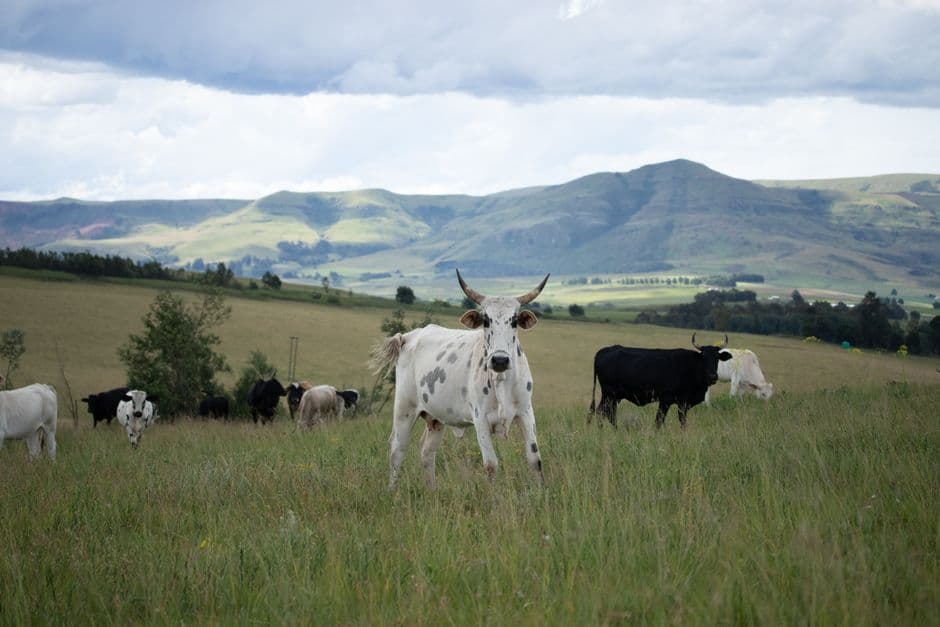
Natural veld and rangeland feed most of Africa's cattle, sheep and goats. It is a renewable resource only if it is used within its limits. Keep too many animals on it for too long and the palatable, productive grasses weaken and die out, bare ground spreads, less rain soaks in and the veld carries fewer animals every year. The key tool for staying within limits is the stocking rate, and the unit that makes it work is the large stock unit.
What is a large stock unit (LSU)?
Different animals eat different amounts. A large stock unit is a standard animal used to add them up on one scale. In Southern Africa, one LSU is commonly defined as an animal of 450 kg that gains 0.5 kg a day on grazing, roughly an adult cow. Other animals are expressed as a fraction or multiple of that, based on how much they eat relative to the standard animal.
| Animal | Approximate LSU |
|---|---|
| Mature cow of about 450 kg (Bonsmara, Brahman-type) | 1.0 |
| Smaller-framed cow, for example Nguni, of about 350 kg | about 0.8 |
| Mature bull | about 1.2 – 1.5 |
| Weaned calf, 6 to 12 months | about 0.4 – 0.6 |
| Sheep, for example Dorper ewe | about 0.15 – 0.17 |
| Goat, for example Boer goat doe | about 0.15 – 0.17 |
| Donkey | about 0.6 |
A common shortcut is that about six sheep or goats equal one LSU. A cow with a calf at foot eats more than a dry cow, so some farmers count a cow-calf pair as more than one LSU.
Grazing capacity
Grazing capacity is how much veld is needed to feed one LSU over the long term without damaging it. It is usually given in hectares per LSU (ha/LSU). The number depends on rainfall, soil and the condition of the veld.
- Higher rainfall grasslands and sourveld can carry an LSU on a few hectares, though sourveld loses quality in winter.
- Mixed bushveld and savanna commonly need somewhere around 6 to 15 ha per LSU.
- Arid and semi-arid areas, such as the Karoo and Kalahari fringes, may need 15 to 40 or more hectares per LSU.
These are wide ranges. Government agriculture departments in several countries publish long-term grazing capacity norms by area, and a pasture scientist or extension officer can do a veld condition assessment on your farm. Veld in poor condition may carry far less than the official norm.
Working out how many animals you can carry
- Measure the grazeable area. Leave out homesteads, lands, roads, dense bush the animals cannot use and badly degraded areas.
- Find the grazing capacity for your area and adjust it for your veld condition.
- Carrying capacity in LSU = grazeable area ÷ ha per LSU.
- Convert to your animals by dividing by each animal's LSU value.
Example: 600 ha of grazeable bushveld at 8 ha/LSU carries 600 ÷ 8 = 75 LSU. If you run Bonsmara cows at 1.0 LSU and keep 10 LSU for bulls and replacement heifers, you have room for about 65 cows. If you also want Dorper ewes, every 6 ewes use about 1 LSU, so 60 ewes would take up 10 LSU and reduce the cow herd to about 55.
Stocking rate versus stocking density
Stocking rate is the number of animals on the whole farm over the year. Stocking density is how many are in one camp at one time. Rotational grazing puts a high density in one camp for a short time and then rests it, while the overall stocking rate stays within the farm's capacity. Rest is what allows grasses to regrow and set seed; many veld management systems include resting each camp for a full growing season every few years.
Adjusting through the season
Grazing capacity is a long-term average, but rainfall is not. In a good year there may be surplus grass; in a dry year there will be much less. Farmers who manage veld well plan ahead:
- Keep a flexible part of the herd, such as young oxen or weaners for sale, that can be sold quickly if the season turns dry.
- Check the grass at the end of the rainy season. What is standing then is roughly what you have to get through the dry season.
- Decide on sales early. Selling before the veld and the animals are in poor condition is better for the veld, the animals and the price.
- Track rainfall on the farm and compare it with the long-term average.
Signs you are overstocked
- Palatable grasses are grazed down to the base while unpalatable species spread.
- Bare patches and soil capping increase, and erosion gullies start.
- Bush encroachment thickens over the years.
- Animals lose condition earlier in the dry season and conception rates fall.
Key points
- Express every animal in large stock units to add up a mixed herd.
- Carrying capacity = grazeable hectares ÷ hectares per LSU.
- Use local grazing capacity norms and a veld condition assessment, not guesswork.
- Keep a flexible portion of the herd and act early in dry years.
- Rest camps so grasses can recover.
This guide gives general information. Conditions differ from farm to farm, so confirm recommendations with your local extension officer, agronomist or veterinarian, and always follow the registered product label.