GuideSoil & Water
Scheduling irrigation with evapotranspiration and crop factors
How much water does your crop actually use this week, and how long should the system run to replace it? This guide explains reference evapotranspiration, crop factors, system efficiency and run times with worked numbers.
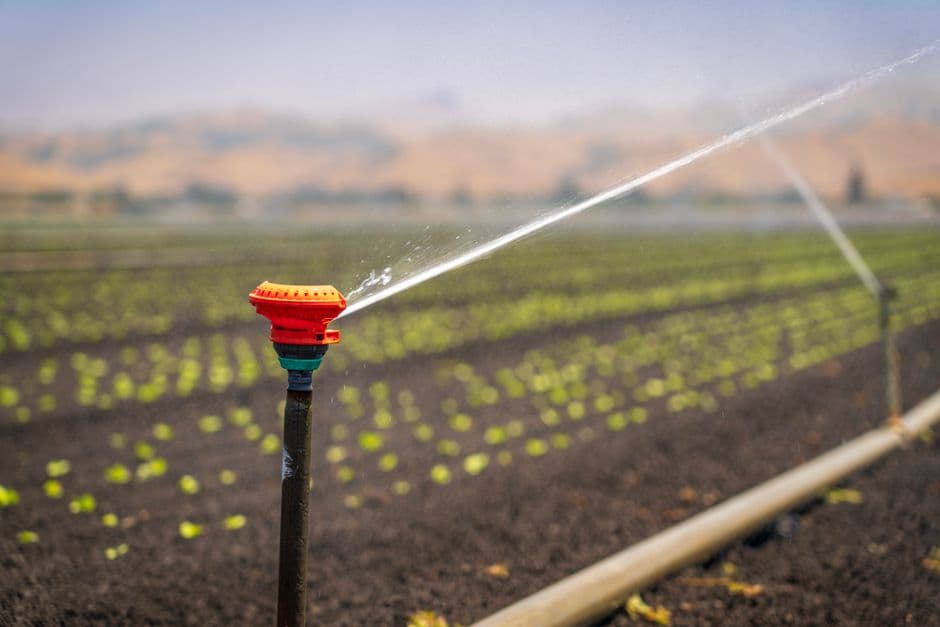
Irrigating by habit, the same number of hours every few days, usually means applying too much water early in the season and too little at peak demand. Too much water costs electricity or diesel, leaches nitrogen past the roots and can waterlog the soil. Too little stresses the crop at the stages where it hurts yield most. Scheduling by crop water use fixes both problems, and the arithmetic is simple.
Reference evapotranspiration (ET₀)
Evapotranspiration is the water lost from the soil surface by evaporation plus the water lost through the leaves by transpiration. Reference evapotranspiration, written ET₀, is the water use of a standard short grass surface that is well watered. It depends only on the weather: sunshine, temperature, humidity and wind. Hot, dry, windy, sunny days have a high ET₀.
Across much of Africa, ET₀ during the growing season is commonly in the range of about 3 to 8 mm per day, lower in cool, cloudy or humid weather and higher in hot, dry, windy conditions. You can get daily ET₀ from a nearby automatic weather station, from national weather services and some irrigation advisory services, or estimate it from gridded weather data.
Crop factor (Kc)
A crop does not use the same water as the reference grass. A young crop with small leaves uses less; a full canopy at flowering can use more. The crop factor, Kc, adjusts for this. Crop water use, ETc, is:
ETc (mm per day) = ET₀ × Kc.
| Stage | Approximate Kc |
|---|---|
| Initial: planting to about 10% ground cover | 0.3 – 0.5 |
| Development: rapid leaf growth | rising from about 0.5 to 1.1 |
| Mid-season: full canopy, tasselling, silking, grain fill | 1.1 – 1.2 |
| Late season: drying down to harvest | falling to about 0.35 – 0.6 |
Other crops follow a similar curve, with their own values. Vegetables, wheat, soybeans, sugarcane and pastures all have published crop factors; your irrigation adviser or supplier can give you values suitable for your region.
From crop use to irrigation need
- Add up ETc for the period you are scheduling, for example the past seven days.
- Subtract effective rainfall. Not all rain counts: light showers evaporate and heavy downpours run off or drain below the roots. A rain gauge on the farm is essential.
- The result is the net irrigation requirement: the water that must reach the root zone.
- Divide by the system efficiency to get the gross amount the system must apply.
| System | Typical efficiency |
|---|---|
| Drip | about 85 – 95% |
| Centre pivot | about 75 – 85% |
| Sprinkler (dragline, quick-coupling) | about 70 – 80% |
| Furrow or flood | about 50 – 65% |
Worked example
Maize at mid-season, average ET₀ of 6 mm per day over a week, Kc of 1.15. Daily crop use = 6 × 1.15 = 6.9 mm. Over seven days that is about 48 mm. The rain gauge recorded 10 mm of effective rain, so the net requirement is 38 mm. With drip at 85 percent efficiency, the gross application is 38 ÷ 0.85 = about 45 mm.
Remember that 1 mm of water over 1 hectare is 10 cubic metres, or 10 000 litres. So 45 mm over one hectare is about 450 m³ of water for the week.
How long to run the system
Run time = gross application in mm ÷ application rate in mm per hour.
- Drip: application rate in mm/h = emitter flow in L/h ÷ (emitter spacing in m × lateral spacing in m). With 1.6 L/h emitters every 0.3 m on laterals 1.5 m apart, the rate is 1.6 ÷ 0.45 = about 3.6 mm per hour. To apply 45 mm takes about 12.5 hours for the week, split across several irrigations.
- Sprinklers: application rate in mm/h = sprinkler flow in L/h ÷ (spacing along the line × spacing between lines, in m).
- Centre pivots: the depth applied is set by the speed of the last tower; use the pivot's chart or controller.
Do not overfill the soil
The soil can only hold a certain amount of water in the root zone. As a rough guide, sandy soils hold something like 40 to 80 mm of plant-available water per metre of depth, loams about 120 to 180 mm and clays somewhat more. Many crops should be irrigated before about half of that available water is used. On a sandy soil that means small, frequent irrigations; on a deep clay, fewer, larger ones. Applying more than the root zone can hold simply drains away, taking nutrients with it.
Check your schedule in the field. A spade, a soil auger or soil moisture sensors will tell you whether water is reaching the roots and whether the soil is drying out as expected.
Key points
- Crop water use = ET₀ × crop factor; the crop factor changes with growth stage.
- Subtract effective rain, then divide by system efficiency to get the gross application.
- 1 mm on 1 hectare = 10 m³ of water.
- Run time = gross mm ÷ system application rate in mm per hour.
- Match irrigation size and frequency to your soil's water-holding capacity, and check the soil.
This guide gives general information. Conditions differ from farm to farm, so confirm recommendations with your local extension officer, agronomist or veterinarian, and always follow the registered product label.